

— DIAGNOSTICS
Execution Intelligence Diagnostics
The diagnostic suite is the entry point into the system. All pathways begin here.

It shows where execution is strong, where it is fragile, and where effort is being lost — through unclear priorities, weak follow-through, poor coordination, or trust breakdown under pressure.
— WHY START WITH DIAGNOSIS
Without diagnosis, organisations respond to execution problems with assumptions.
— The Usual Diagnosis
— More meetings.
— More reporting.
— More leadership development
— More structure.
— More urgency.
Sometimes those help. Often they do not — because they are not addressing the real constraint.
The diagnostic provides a clearer starting point.
— WHEN DIAGNOSIS IS USEFUL
A diagnostic is particularly useful when execution is quietly weakening.
— You May Recognise
— Strategy is not translating into delivery.
— Teams appear busy but misaligned.
— Decisions are being revisited.
— Coordination is breaking at boundaries.
— Boards want earlier visibility of execution risk.
— WHAT IT MEASURES
A practical picture of what is holding together — and what is not.
— Execution Intelligence Diagnostics measure
— The five execution conditions.
— Trust behaviours.
— Where execution fragility sits across leader, team, or enterprise levels.
— The patterns most likely to be affecting delivery.
— DIAGNOSTIC OPTIONS
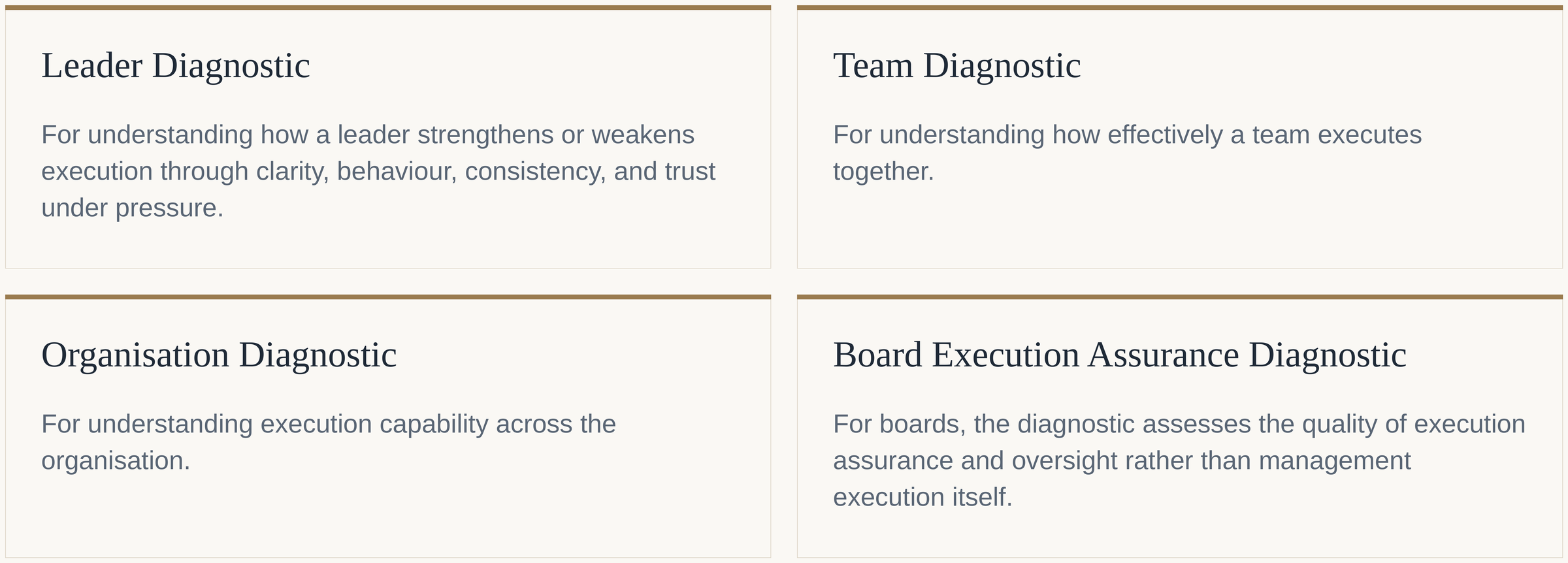
Four diagnostics, matched to the level where execution is being tested.
— WHAT YOU RECEIVE
The aim is not another report. It is a clearer view of what should happen next.
— A diagnostic engagement typically provides
— A structured execution profile.
— Strengths and constraints.
— Key pattern insights.
— A debrief conversation.
— Clear priorities and a recommended next-step pathway, based on the evidence.
Execution rarely fails suddenly. It weakens quietly.
— START HERE
The diagnostic provides visibility before fragility becomes visible in performance.